Passover Falling

OLYMPUS DIGITAL CAMERAIt’s April. I almost forgot even though last night on Jimmy Kimmel they were doing April Fool’s pranks. I guess it didn’t stick because it was my second choice, having changed the channel from Colbert when he put his face behind the grill and began his “midnight confessions”. All these late night talented comedians and commentators are part of my bedtime ritual like the evening “Shema”. Some of the time I put the TV on a 30 minute automatic shut off mode; on good nights, I just trust I can fall asleep without their white noise.

I remembered it was April this morning when into my inbox Knopf flew the first in a month long poem of the day for National Poetry Month. I love the anticipation of these emails, knowing full well that they are a challenge and an opportunity to see the world differently, to feel the world obliquely, to be present uniquely inside the heart, mind, “kishkes” of the author. Like my late night television personalities, with whom I am not always in sync, I often don’t succeed in understanding the poets and their motivations. But that’s Ok because for me it’s all about reaching, stretching, wrestling.

Passover or part of it almost always falls during poetry month. Passover actually doesn’t fall. A fall is almost always accidental and there is nothing accidental about Passover. Not if you know the holiday and all the preparation it demands depending on your comfort level with leaven. I take my own advice about leading a Seder purposefully seriously. So yesterday I was tinkering with using the website Haggadot.com that gives you the tools to create your own personal Haggadah with clips, resources and templates from traditional to contemporary to humanist to atheist – you name it. This morning I counted up how many copies of the same Haggadah we own to see if the number matched with a how many people we’ve invited to the Seder. (What’s wrong with sharing?)

For me, Passover is an intricate and complex poem. The words, questions, songs, symbols, rituals all point somewhere other that where we are. The story we tell is ever old, ever new.   The bitter herbs we dip grow in gardens near and far. The wine we lick off our fingers numbering ten suffers ancient and contemporary deaths. The open door brings a breeze of fear mingled with hope. The questions we ask ultimately lead me to faith. The God we invoke, praise, entreat a God of yearning, freedom, aspiration.

This puzzle we call Passover is much like the mystery we call life. It is a journey from unknowing to knowing and back again. It is free men and women becoming slaves, wresting a journey to a promised land of liberty only to be stuck in a desert of fear. It is trusting we can get out of the narrow places and into the wide starry darkness of eternity. It is believing nothing is accidental.

Passover doesn’t just fall.
The Hidden Haman

first-they-came-forMaybe it is time to reread Nathan Englander’s, book of short stories: “What Do We Talk About When We Talk About Anne Frank.”   Not that the book is a formula for what you do when Jewish Community Centers and Day Schools receive bomb threats. But given the events of recent weeks, I am beginning to think about the Anne Frank conversation.
In Englander’s story, the Anne Frank conversation is a four-person exchange. It comes after a lot of drama and a little bit of pot. What would you do if they came again? Who would you trust to hide you? Is there a righteous gentile in your neighborhood? (Sorry Mr. Rogers).   It is mind boggling to me that the news brings this story back to life. And when I say ‘news’ I mean real hard facts, not fake news or alternative facts.

This is how the internal conversation begins for me: Is this all an isolated phenomenon, although the answer is in the first paragraph of the Wall Street Journal article. “This is the fifth wave of such incidents this year.” I need someone to speak up; I need someone to tell me that my government cares about this; I need to know I can trust that law enforcement is putting appropriate resources into this. I need to feel protected or it is time to take action in a different kind of way and turn the ADL into the JDL.

There I said it. To everything, turn, turn, turn. There is a season, turn, turn turn. Is it our turn here in America? Is Anti-Semitism a new fact of life and this is the beginning of a different reality or this is the same reality that was always underground and now has been given permission to surface?  And what is it with Jewish cemeteries. The Jews in there are dead already. Is that the ultimate in hatred – they can’t be left to rest in peace?

Some of us saw this coming when they started attacking and burning Mosques. Some of us heard the thunder when in the last Presidential campaign words were used as swords. Some didn’t want to believe it could happen here. When Harry Golden said: Only in America, we heard: Never in America. I want my congressman to go to my local JCC and affirm there is no place for bigotry against any minority of religion, color, language, or culture in this America. I want my President to demand an investigation. I want the Jews in his inner circle to tell him: These are my people; this is my pain; find the hidden Haman wherever he may be.

I always thought the Book of Esther was fiction like Englander’s Anne Frank story. I’m afraid not.

Chrismukkah

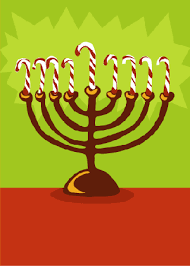
candy-cane-menorahOne source says that this is the first time in over fifty years that the first day of Hanukkah and Christmas coincide. The Jews are excited. Maybe even more excited than when Hanukkah and Thanksgiving came together in 2013. That’s when two women from the Boston area coined the phrase “Thanksgivikah.” Of course “Chrismukkah” is even older than that. It comes from the once popular TV show “OC” when Seth Cohen coined the phrase to reflect his interfaith upbringing. In 2004, the phrase “Chrismukkah” was one of Time Magazine’s words of the year! That same year the New York Catholic League and the New York Board of Rabbis issued a joint statement condemning the union of both holidays.
So is this good for the Jews or bad for the Jews? Of course, you probably already know the answer. It depends on where you are coming from on the spectrum of particularism vs. universalism or where you find your comfort level when it comes to symbols and rituals that morph over time and sometimes actually reverse the course of their original meaning. This much is clear to me: Unless you live in a walled city with no Internet or TV access this syncretism is inevitable. What we can do is try to keep faith with the essence of our message and make it as relevant as possible.

We are not the first to struggle and question this holiday that begins on the 25th day of the Hebrew month of Kislev. The codifiers of the Talmud record a fascinating rabbinic discussion that begins with the words: “What is Hanukkah?” As if they didn’t know; as if they weren’t already teaching about how you light the lights associated with the holiday; as if they hadn’t read the Book of Maccabees. The discussion takes place somewhere in the second century. Roman rule is repressive; military options against the oppressors have been exhausted; the Temple is in ruins; two revolts have been quelled. Enter the miracle of oil. Enter a new narrative for the military victory. Enter the words from Zechariah, “Not by might and not by power but by My spirit says the Lord of Hosts.” Enter a redefinition of Hanukkah.

Personally, I am not a fan of miracles.   So the oil doesn’t do it for me. I like the light. I love adding a new light every evening. I love seeing the candles increase in power. I feel their warmth building night after night till they fill up all the holes in the Menorah and it is complete or so we think and so we say. But it is never complete. There is always a darkness out there that needs our light. I believe the miracle of Hanukkah is that we are the ones who fill the void, chase away the shadows, shower stars on the year’s longest nights.

This is where Hanukkah and Christmas find common ground for me. The baby born on the 25th brings hope. The lights that celebrate his birth remind me of the dedication of the Maccabees that the tomorrow we hope and pray for will not happen by itself. It takes grit and striking a match to kindle candles of caring. All these presents we wrap in red and green or blue and white are beautiful extensions of our reaching out to each other.

Jimmy Kimmel said the difference between Hanukkah and Christmas is that Christmas kids get all their presents on one glorious morning. Hanukkah kids get them spread out over eight nights. I’m not entering the debate as to which is better. This is what I know.   The best gift we can give each other is the present of knowing it is up to us to make the world brighter. It is up to us to elevate holiness and joy. It is up to us to care, give, love. And faith? I have faith that someday we will get it: We are in it together – that’s the miracle.


Babka Is Back

babka_duo_index1a

I don’t usually do this but to “get” this blog you might like to go back a few months to the blog of January 17th titled, “Is It Good Enough?” It was about these blue cards I found that date back to the 70’s – sermons – typed – like on a typewriter – and filed away, forgotten till now.

I was reluctant to read them, not knowing what I would find: Were they good; have I grown; did I bring insight and meaning to my listeners? They are my “chameitz” – the yeast that causes the dough to rise. Passover is over but all that attention to labels and order freed me from the power of the past to bubble up and control me. Passover worked for me; it gave me the ability to start again knowing the doubts and sense of inadequacy would be back, but that’s why we play this Seder game year after year.

So the genie is out of the box. I’ve opened the files and on a beautiful Florida day, I schlepped them outside and sat in the sun reading my past. It helped that our granddaughter, Sammy, was sitting next to me. So here are a few reflections.

They are mostly High Holy Day Sermons and they are mostly too long. I think I love my words too  much and find it hard to hit the delete button. But they are interesting in ways that surprise me. Themes reoccur: I talk a lot about my self and what I am struggling with (as a parent, a teacher, a believer, a skeptic). I talk a lot about Israel; it is fascinating to see  how that conversation has changed over the years.

There are some good stories that I have forgotten and can probably use again. Like: “When a Yeshiva student came to his Rebbe and boasted that he had gone through the Talmud five times, the Rebbe turned and asked: ‘And how many times has the Talmud gone through you?’” It leads me to ask: How much have these words gone through me?

My eyes were better then. I can’t believe the size of the typewriter font. But was my vision? I’m impressed that even then when Israel’s survival was sometimes in doubt, I thought out loud “survival can not be enough. We cannot be dependent on our enemies to define us.” Why be Jewish is not a rhetorical question; it touches the heart and the soul of each of us.

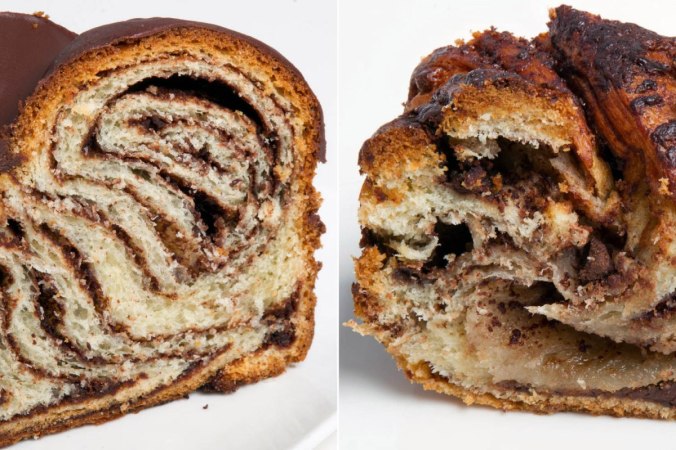
Forty years ago, in 5736, (I dated my files by the Jewish year), I announced, “Babka is back” and in 5776 its back again. According to the Today show it is here to replace the cronut as the latest pastry obsession. Everything is cyclical or as we use to say in New Jersey: “What goes around comes around”. But that has a somewhat different connotation and usually involved a little bit of self-satisfying glee. It is good to be right. Which brings me to an ending. I wasn’t always good. I wasn’t always smart. But I tried and sweated out every word. I tried to reach beyond the lectern. I laughed when I read one of my sermon openings: “Relax – let down your defenses – I am not here to yell at you. I am here to search with you.”  Yes – for leaven, for yeast, for anything that can help us rise above ourselves.

And by the way or to the point:  where is there good Babka in South Florida (chocolate – the deep dark rich kind that doesn’t crumble when you cut it, that can be toasted and spread with butter.)?  OMG, I’m in trouble.


Yellow Blossoms & Matzah Crumbs

Image 4-7-16 at 11.20 AMI like April. It is Purim behind, Passover in front and Easter floating somewhere in between, tied to the first full moon after light and darkness halve the day. Esther averts her people from pending destruction; Moses leads the Israelite slaves on a journey to a promised land; Jesus becomes more than anyone thought he could be: salvation, deliverance, redemption.
I like April. It is National Poetry Month and every day I receive a new poem in my mailbox. They humble me these poems like todays by Robin Coste Lewis. The author restricts her words to fragments of book titles, catalog and exhibit entries in which a Black female figure is represented. She brings us a meditation on race and a record of a different kind of journey through time and place, also one of promise but like almost all, still unfulfilled.

I like daffodils fighting to break through winters hard and unforgiving crust demanding we will be born again; dogwood trees blossoming stark white against the deep dark bark. And for those of you who are Florida averse and complain you miss the seasons, driving home yesterday, I caught this Tabebuia trumpeting hints of grace and salvation just next to the curb. They like to drop their leaves in March and early April, replacing them with these brilliant yellow flowers. We had one once but for all its splendor ours blew over in a storm, either the roots too shallow or the wood too brittle. There is a price to pay for almost everything, including beauty.

I like this holiday of spring that calls on me to renew myself. I like searching for the parts of me I think could be better. I like the questions that spiritual work engenders. There are at least four. It brings me to Passover and all its symbolism and rituals; it brings me to Passover and all its rules about which way I lean and what I can eat. This year it is really late – I know the lunar calendar verses the solar and the need to add an extra month to the Hebrew calendar so that holidays hang in there on time and Passover doesn’t migrate across the years to mid summer. But this year I appreciate the extra time it is giving me. It feels like there is breathing room to prepare for the Seder with all its directions and instructions.

“Break the middle Matzah in half.” How did they know that’s impossible?  There is always inequity. And they take that reality and make it work – save the larger piece for the Afikomen, a sacred game of hide and seek. That broken piece of Matzah is well over half the world who are still waiting for us to find them and help them become whole. That ridged, perforated, flat excuse for bread commands us not only to remember that we were slaves but also to act, to care, to reach out in compassion for those whose lives are still embittered

The yellow tree is poetry; it is Passover; it is a promise of potential. The winter is gone; new life is blossoming. Indifference to the myriad of plagues that flood our inbox need not be a permanent affliction. We have power; we can change tomorrow; we can do it one matzah crumb at a time; just picking up the pieces and remembering – this year we are slaves; next year may we all be free.


My New Favorite Word

Screen Shot 2015-12-22 at 1.54.14 PM

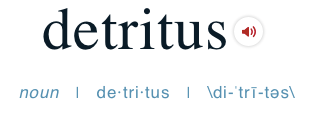
I was at the Dermatologist last week and was told that the bite on my leg that would not go away or stop itching was not from a tick and I didn’t have lime disease. But you never know what detritus the insect that bit me left behind and how the body reacts to it. Context told me what the word, detritus, meant but truth is it is not in my everyday vocabulary. This morning it popped up again on my ipad as I was reading this Danish mystery trying to get a sweat going on the elliptical machine. The inspector seeking to interview a person of interest in a long unsolved murder noticed all the detritus on the front lawn: an old and rusty bicycle; over worn lawn furniture; scraps of life now discarded and left to decay and be transformed. Of course the novel was written in Danish, so I guess it is the translator who chose the word.

Nevertheless, detritus is my new favorite word. Webster defines the word as loose material resulting from disintegration, especially organic; miscellaneous remnants. So I can think about the detritus of my physical being – all that dry skin just flaking off and floating into nowhere. (There is a dermatology theme going on here.) Or the detritus of my relationships – all those people who have sifted through my life and now are somewhere long out of sight (but not memory). Or the things I have done both positive and negative the effects of which are out there still rippling in the spiritual cosmos.

I believe that. Everything we do has consequences, some barely perceptible in the here and now, deeds and acts that change the very space we occupy and imperceptibly but assuredly modify what the future will look like. For most of us it is a subtle and delicate process. But I think how I interacted with the server at Cheesecake last night impacts both of us. I think my decision not to have the salted caramel cheesecake was a good one even beyond the calorie/cholesterol debate happening in my head. I think that the driver of the car I let get out of his clogged lane of traffic and into mine that was somewhat clear and would probably make the light will feel differently about himself and humanity in general at least for an instant. I think, well actually hope, that what I decide to write in this blog impacts some of you (me included) and transforms even if for a moment the way we look at the world and our place in it.

I think I should save this blog until closer to New Year’s but there is always something that is left over, unfinished, or unwrapped, laying out in the yard, patiently waiting for resolution. That is part and parcel of the message of this season: picking up the pieces, keeping your spiritual footprint pointed in the right direction, trailing blessings as you move through your day. It is the lights, the candles, the music, the parties, the presents, the stories, the preparation, the food, the friends and even family, and it is hope and it is faith.   Hope that we can find a way towards healing this fractured world; faith that we can clean up the detritus of the past and move forward each of us owning what we have left behind.