God Thoughts

flower windI just read three stunning sentences. They made me stop and reflect on how they are calling to me. They are from a book that my friend and co-teacher Tom O’Brien recommended. We were preparing for our class (God, Politics and Culture) at Florida Atlantic University’s Life Long Learning Society and we were talking about “The Problem of God”.

We were asking, what does the word, God, mean? The problem is when people proudly say; ‘I don’t believe in God”, something inside me wants to respond and sometimes does: “Which God do you not believe in?” More often than not, I don’t believe in that God either.

The book is called, “A God That Could Be Real” by Nancy Ellen Abrams. Here are the sentences: “Has something terrible ever happened to you or to someone you love? God had nothing to do with it; God doesn’t control events. God influences how we see the events and interpret them.”

Maybe out of context they are not as stunning as I thought they were. But this is what they said to me. This world is hanging on by a thread. There is so much violence, anger and terror. Perfectly innocent people get killed at a moment’s notice as they fly home from snorkeling in the Red Sea, as they walk near a mall in Beirut, as they wait for AAA by the side of their car in Florida, as they sit in a classroom in their University, as they attend a concert in Paris, because they are black, because they are white, because they are women, because their gender identification calls them to dress differently, or for no good or bad reason at all. And it is not God’s fault. “God has nothing to do with it.”

So what does God do if God doesn’t hang out there in the universe moving people, clouds and planets? And why is it important anyway? Because people are getting killed in God’s name (again); because people are using what they call religion to justify evil behavior (again); because people and politicians find that the God word is a convenient excuse to bully people into believing that there is only one path forward for America, one way to make America great (again).

I recently heard Rabbi Donniel Hartman speak about his new book, “Putting God Second”. I love the title. It is a great metaphor almost like theological poetry. I hope this isn’t blasphemy but for me, that’s where God “resides” – behind us motivating and inspiring us to put people front and first. The image in my head is from Genesis when the “wind” of God is hovering over the surface of the waters. I see the water rippling and God is pushing it so the dry land may appear. I feel God separating light from darkness so there can be daylight.

God is behind the scenes inspiring me to be the best I can be so that the world around me is more compassionate, kind and caring. And one more thing: God can only work through us. Our actions, our love, the way we walk through this world and navigate with the people around us, all of the above, allow God to “be”.

It is early morning; the house is quiet; the traffic hasn’t hit its peak; I can hear the birds singing outside. I wonder if they feel the wind of God lifting their wings, pushing at their backs also.
I Am Not Usually Political

DemsRepubsI am not excited with our presidential political process yet. I should be; there certainly has been enough drama and the spectacle has unquestionably been anything but flat. But it’s been a show. The real issues that touch people’s lives and that impact our culture and society are back stage and haven’t broken through the fourth wall.
Not that they haven’t tried. I think there have been six Republican and five Democratic debates so far. The sponsoring network tries to make the run up and the follow up compelling, but somehow I don’t feel connected. And I’m not being partisan here – this sense I have crosses both party lines.

I have tried to figure out why. It is no secret to most people who know me that I was energized eight years ago, excited in “the change we can believe in”. It is just none of the candidates work for me. Conceptually, I would love to see a woman president. With some embarrassment I say, I would love to see a Jewish president, no matter how unobservant. With a little bit of trepidation, I timidly say I would love to see a young and bright candidate whose family are recent immigrants. But nothing is motivating me, until this morning.

Front page of the New York Times, next to a picture of two feet of snow in Prospect Park, Brooklyn, there is this headline. “Bloomberg Is Considering 3rd Party Bid.” My heart soared. I read the article through carefully. Is there really a chance that a knight in shining armor can come and save this our beloved country? Is there really someone who can galvanize all those people like me who are sick of politics the way it is being played out and don’t want to vote for any of the current runners? Is there hope?

Here comes the caveat and my need to back peddle a little bit and make sure I am being clear here.  These words are not an endorsement of Michael Bloomberg. They are a testimony to the need for someone in this political process to understand me and people like me: life-time democrat who believes in an agenda firmly rooted in America’s promise in the potential and right of every individual to live up to their highest potential no matter where they were born, how much pigment they have in their skin, what their religion, what their faith. To know that I am looking for a president who can unite this country with a practical vision that encompasses a plan to address a crumbling infrastructure which for me means bridges and roads but not just physical ones: bridges between races, roads that promise pathways to the American dream for the poor and underprivileged, beltways that force politicians to face the real problems of gun violence and terror both home grown and imported. I want a president who can bring us together and make me believe in the American political process again.

Am I expecting too much? Am I an inveterate and impossibly naïve dreamer? Am I looking for the messiah? You tell me.


Is It Good Enough?

old filing cab

It is at least seven weeks since a metal box containing files with 6 x 8 blue note cards was found in a storage room at the Temple. The blue cards were all filed neatly with rubber bands around each pile, rubber bands that if you touch, now break from age and dryness, even in this Florida humidity. Most of them are typed and they have dates and occasions, rarely titles. It has taken me till this morning to look into this file box. I’m not sure what I was afraid I would find.

They are sermons from the 1970’s. (I know some of you reading this weren’t even born.) I don’t know what is keeping me from going through them. I think it is an adequacy issues – are they good enough. It reminds me when I first began Spiritual Direction. My “director” was a Roman Catholic Dominican Sister who works at a retreat center nearby. When I started she encouraged me to write and journal. I chose to record my sense of the sacred and what being spiritual meant to me at that moment through poetry. The first time I shared a poem with her, she responded with silence. There was lots of silence in those spiritual direction sessions. But I was new and the absence of words felt strange. I jumped right in: Is it good, I asked.

Is it good? There it is. Are they good – those words typed in dark black ink on light blue cards? What has 40 plus years done to them? What have they done to the 40 years? Forty is a special number in both the Hebrew and Christian Scriptures. It rained for forty days and nights as Noah’s ark floated back and forth across the waters. The Israelites wandered for forty years in the wilderness till they were ready to cross the Jordan. Jesus was tempted for 40 days and nights till he passed the test. And that is just for starters. Some say forty is associated with humility; some say transition/change.

I am going to read what’s in that box – there is no doubt in my mind, but not just yet. I don’t know why but it definitely is an adequacy issue. Or maybe it goes back to the symbolic number of the biblical forty. Am I humble enough to be willing to see that I have changed/grown/developed over the years and life is all about transition? Am I strong enough to recognize that maybe I didn’t? The days and the years grow you; the trials and the tests refine you; the blessings, challenges, opportunities and failures hone and polish. Am I willing to accept that some of them may just not meet my over perceived and probably falsely filled standards and some of them may just be plain dated or lousy or saturated with unrealized potential?

This has been helpful; thanks for hanging in with me. I think reading them would be a good exercise in humility. I think it will “grow” me. Stay tuned.


2015: A Hell of a Year


nafs-480x278

It’s been a hell of a year. Are they all like this or was this one just so intense and filled with so many shocking moments that we were reeling from what was happening both during and after. What did it all mean for our children, for our society, our future and us? We struggle with how to respond. We always do. Genesis tells us the story of Jacob wrestling with an unknown man ultimately forcing a blessing and a new name out of his protagonist. Jacob becomes Israel – the one who struggles with God and what it means to believe, to affirm goodness in a dark and fractured world, to stay true to our core values.

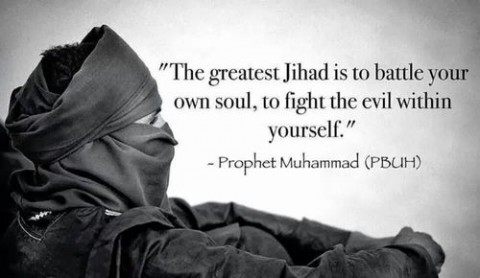
Different religious traditions describe this struggle differently. One of the words in the Muslim tradition for this process is Jihad. Yes, it can refer to a holy war against non-believers, but at its essence it speaks to the internal battle that wages within us between doing what is right living to our highest standards and doing what is expedient and giving in to our base fears. You can position this process in many different frames. Some scaffold it within a religious setting, speaking about the need to submit to the will of God or Allah or Jesus or HaShem (all basically synonyms for the Unknowable). Some frame it within a spiritual and ethical self-improvement venue articulating the need for balance and living in sync with the laws of nature and society. No matter where you are positioned, all of us struggle.

In Judaism we call it the tension between the “Yetzer Hatov and the Yetzer HaRa” – the Good and the Bad Inclination. (Don’t read too much into those words “good” and “bad”, it is way too complicated for 500 words.) Just know we are always weighing our options. No matter what the situation, we choose where to live internally. Shall I live with the fear of terrorism; shall I dwell in the resentment of my freedom of movement being curtailed; shall I sit with the frustration of knowing that Big Brother is listening and George Orwell’s “1984” is closer to prophecy than science fiction. And whom shall I blame and how shall I direct my anger?

As a nation we are in that moment right now. There are those who feed our fears and tell us that the solution is to label those who follow Islam our enemies. There is a tendency to want to find that scapegoat with talk of walls and religious identity cards.

All of that tells me that we need to acknowledge that as real as the problem is outside of us that there are people with guns and bombs who want to destroy our way of living, there is also a challenge inside as well. We need smart and effective ways of dealing with the external threat and we need a conscious awareness that there is a struggle going on a gut level between our fears and darker instincts to close down and circle the wagons and our higher aspirations to be welcoming and open to people in need and ideas that challenge. Islam as a spiritual tradition has much to teach. The word Jihad reflects that struggle. It is an internal process of choosing hope rather than fear, faith rather than despair, acceptance and understanding rather than rejecting and stereotyping those who call God by a different name. We need to be willing to learn from all our traditions and we need to live in that struggle. Out of it comes blessing.

My New Favorite Word

Screen Shot 2015-12-22 at 1.54.14 PM

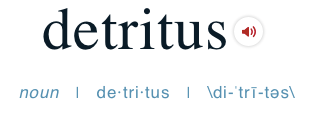
I was at the Dermatologist last week and was told that the bite on my leg that would not go away or stop itching was not from a tick and I didn’t have lime disease. But you never know what detritus the insect that bit me left behind and how the body reacts to it. Context told me what the word, detritus, meant but truth is it is not in my everyday vocabulary. This morning it popped up again on my ipad as I was reading this Danish mystery trying to get a sweat going on the elliptical machine. The inspector seeking to interview a person of interest in a long unsolved murder noticed all the detritus on the front lawn: an old and rusty bicycle; over worn lawn furniture; scraps of life now discarded and left to decay and be transformed. Of course the novel was written in Danish, so I guess it is the translator who chose the word.

Nevertheless, detritus is my new favorite word. Webster defines the word as loose material resulting from disintegration, especially organic; miscellaneous remnants. So I can think about the detritus of my physical being – all that dry skin just flaking off and floating into nowhere. (There is a dermatology theme going on here.) Or the detritus of my relationships – all those people who have sifted through my life and now are somewhere long out of sight (but not memory). Or the things I have done both positive and negative the effects of which are out there still rippling in the spiritual cosmos.

I believe that. Everything we do has consequences, some barely perceptible in the here and now, deeds and acts that change the very space we occupy and imperceptibly but assuredly modify what the future will look like. For most of us it is a subtle and delicate process. But I think how I interacted with the server at Cheesecake last night impacts both of us. I think my decision not to have the salted caramel cheesecake was a good one even beyond the calorie/cholesterol debate happening in my head. I think that the driver of the car I let get out of his clogged lane of traffic and into mine that was somewhat clear and would probably make the light will feel differently about himself and humanity in general at least for an instant. I think, well actually hope, that what I decide to write in this blog impacts some of you (me included) and transforms even if for a moment the way we look at the world and our place in it.

I think I should save this blog until closer to New Year’s but there is always something that is left over, unfinished, or unwrapped, laying out in the yard, patiently waiting for resolution. That is part and parcel of the message of this season: picking up the pieces, keeping your spiritual footprint pointed in the right direction, trailing blessings as you move through your day. It is the lights, the candles, the music, the parties, the presents, the stories, the preparation, the food, the friends and even family, and it is hope and it is faith.   Hope that we can find a way towards healing this fractured world; faith that we can clean up the detritus of the past and move forward each of us owning what we have left behind.


Paris- No Words

eiffel-tower-01-800

I don’t know what to say. I have jettisoned the words I was preparing to post for this week. They pale to the events in Paris and the 128 plus people dead at this moment. Six different venues targeted. The same words scroll across the bottom of the screen as images of people running in the night and people placing flowers, lighting candles, at a make shift shrine in the morning. I could become news junky, glued to the TV and listen to experts and world leaders try to help us make sense of the senseless.

But there is no sense here. There is violence; there is death; there is evil, unspeakable evil. But we have to speak of it; we have to no choice. World leaders have to assure us that everything is being done to protect us; that we stand with Paris and understand that the attack is a clash between cultures and civilizations. As Pope Francis put it just this morning: It is part of a piecemeal Third World War.

I’m struggling to say something new or profound. Maybe that is too hard a task. There is nothing new to say. We can reiterate what we have said before: We will fight for the survival of our values; we will do everything we can to protect ourselves; we will not surrender to fear; we will not be paralyzed by our anxieties. We have faced evil like this before, not necessarily in this specific form, but there have always been enemies of our way of life that have attacked at the rear of the column, where the unarmed, the unprepared, the frail and the innocent congregate.

It is a terrible fact of contemporary life. I still have CNN on and I watch as my grandchildren float in and out of the room and I wonder how they see this through their eyes. What does it do to their view of the world? Are they able to compartmentalize it and still giggle and laugh at the silly, the absurd, the imaginary?

Less is more in this case. The Bible says it best. “I have set before you life and death, the blessings and the curse. Choose life that you and your children may live.” Fear is not an option. Isolation is not a choice. Hatred, stereotyping and collective blame do not help us deal effectively with how we go forward. Living does; loving does; affirming all that is good is our society will. Choosing to live.

“Houston, We Have a Problem”

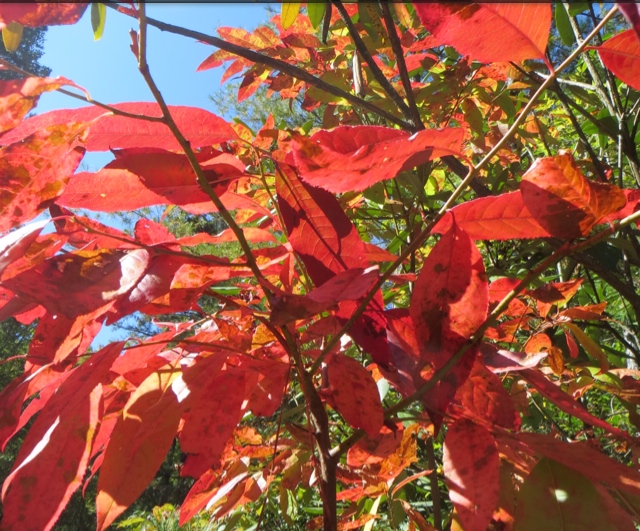
IMG_0462I miss the leaves in Autumn. I miss how they change and seemingly have a mind of their own when they will go from green to gold or red and shades in between. Living in South Florida, we don’t get dramatic announcements that the seasons are changing. I could be cute though and tell you that we know the season is upon us as we watch the car carriers’ park in the middle of the road outside our gated communities and slowly shed their cargo onto the road below. They are of many colors and shapes but not quite up to comparison with a Sugar Maple or Black Tupelo.

There are other hints as well. There are fewer reservations available at your favorite restaurant; the white holiday lights strung around Banyan and Palm trees, outlining their trunks and branches are slowly turning on as the days grow shorter; all the multi-colored annuals are bedded and sprinklers are furiously making sure that they root and take. But they don’t equate with the drama of the sun-filtered reds, gold, yellow and oranges of a tree standing proud against a deep blue sky.

But I’m not complaining and I’m not dissing Florida. I love where I live and am blessed to be here. I believe that the pervasive and sometimes oppressive humidity is actually Ponce De Leon’s fountain of youth and no matter what the mirror tells me, it keeps my skin young. I believe that the understated modifications that mark the changing seasons teach us something about how most change occurs, subtly, delicately, one step at a time. I believe that each of us can affect that change – we just have to realize how crucial it is that we learn it doesn’t happen without us.

Unfortunately change/progress isn’t as predictable as the seasons. I’m thinking about the equal rights ordinance that was repealed in Houston this week. Voters rejected the measure that would have barred discrimination against the LGBT community. The campaign was down and dirty. They appealed to our baser instincts claiming sexual predators would have access to women’s bathrooms and locker rooms. The failure to protect people from racial, ethnic and gender discrimination puts Houston in the position of being the only major American city without a broad anti-discrimination policy. The line from Apollo 13 applies here: “Houston, we have a problem.”

The greatness of our country is that we have been a people of many colors, many backgrounds, different ethnicities and different sexual orientations. We didn’t always recognize that and we often ignored the rights of those whom we perceived as other, but slowly, surely, one foot in front of the other, we are coming to see that the tree has many branches and that some trees actually have leaves of variant hues and shades on the same trunk.

The political commentators tell us that the take away from Houston’s vote is that turnout counts. And the people who were afraid and misinformed turned out in great numbers to vote. The people who want rainbow leaves to be treated with respect and dignity did not get the message. Change happens – but it is up to us to make sure that the leaves reach the ground and nourish the growth of tomorrow.

Guardians of the Future

DSCN1981“If you keep digging, we’ll hit China.” That’s what they used to say when we piled sand upon sand, digging holes, building castles and no one worried about how tan we got. Well, we’ve just returned from China and in the sites and cities we visited, China isn’t at the bottom of a hole. China is very much in this world and China looks like the future. And it isn’t all panda bears and pagodas, forbidden cities and clay warriors.

It is smog and pollution; it is unbelievable traffic; it is concrete apartment buildings to house millions of people in cities the size of counties; it is sensory overload with neon signs in red Chinese characters and sky scrapers illuminated in colors and designs, flashing against the dark, proclaiming we are here: notice us; pay attention.

It is a proud people with good reason to be proud. It is a heritage of great beauty and symmetry with a wall that was built to keep the invaders out and the “cultured” in. It is rice and noodles and soy sauce; it is tea and Chinese beer that is one of the few things that taste good without ice. It is the “chutzpah” of the Three Gorges Dam, creating the largest hydro power station in the world, dislocating in the process 1.2 million people and submerging well over 100 towns and villages.

Don’t get me wrong. It is beautiful; it is exciting; it was a privilege to feel its enormous energy and see the delicate harmony ancient Chinese artisans created in the way they designed their palaces and gardens, their tombs and their temples. I loved it and if it weren’t for the flight would go back in a minute (ok, not a minute) because I know there is so much more to see, experience and learn.

Like: If we do not figure out how we create energy and keep polluting the air, then I invite you to taste the smog in the back of your throat and walk around with itchy eyes and wonder what is happening to your lungs. We were lucky. We had just a few days of pollution. But it was enough to make me yearn for the clear blue skies of a beautiful sunny day.

Like: If we do not figure out how to move people around efficiently and keep building rings and rings of roads and elevated highways decked two and three times above the streets, then I invite you to sit in traffic jams that rob you of your day and precious hours with family and friends. It was enough to make me fear for the future because this isn’t about China; it is about all of our 21st century cities.

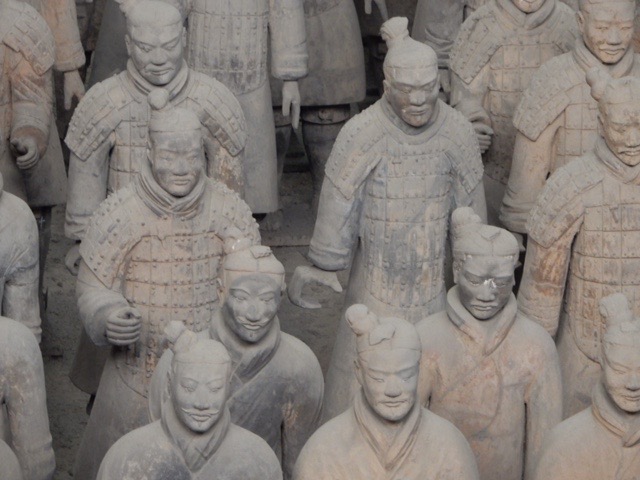
Like: The Terra Cotta Soldiers have guarded the Chinese Emperor’s tomb for centuries. They have stood in a dark still silence, buried from sight and blind to the present. They are only clay, and yet, you look at them and feel their steadfast power. It makes me wonder: Who will guard our future? Who will vision a cleaner, clearer, brighter tomorrow for us and for our children? Or do all our politicians care only about the emperor and the trappings of power? Some of them talk about building a wall. To protect who from whom?

That’s a “Hallelujah”

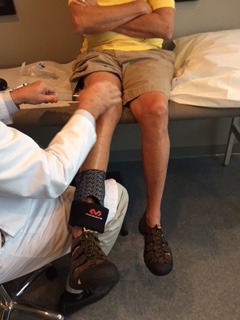
IMG_4111I turned over in bed this morning, barely awake and did something to my knee. I heard it click, could feel it wrench and boom pain. That woke me up. I knew immediately that this wasn’t good. As I tried to put weight on it, I felt as though I needed to hold on to the furniture around the room as I tried to walk it off – hopeful I could do just that. What have I done or what has my body done to me? What about the vacation we are supposed to embark on in two days, the one with all that walking, the one I have been testing out new shoes and sneakers for?  This is not an exercise in self-pity and it is not a call for your sympathy, although if my Doctor is reading this, got room tomorrow in your schedule?  It is that fundamental truth underlying all our dreams, expectations and plans for the future that we are one second and one movement away from knowing in our bones how capricious and unstable life is.  I know, when you are young and your body is your temple you live in it with grace and confidence. And then again, our culture tells us that the more you exercise and take care of it, the more and the longer you can expect your physical being to cooperate and live up to your demands and hopes.

I am here to tell you yes, till no.

I am here to tell you don’t take any of it for granted. I know that’s hard. It’s not like you can walk down the street and sing praise for your health and abilities constantly. You have to make sure you are crossing in a cross walk; not bumping into people or things; are aware of your surroundings. But somewhere in your day, either when you wake up or go to sleep, there is a moment there. When you let your eyes see again; when you let your mind rest again. When you let go or when you hold on. There is this opportunity to say a blessing; to just say thank you for all that works in your life, even if imperfectly.

And I don’t promise that the blessing or the prayer will act as a personal insurance policy against the storm. I think it can be a change agent; I think it can make you (me) more sensitive and more aware. Sensitive to those whose health and mobility is different than yours; aware that what we have is good and needs to be affirmed and appreciated. It make us better people; it makes the lives we live in tune with love and hope and what some people call God. It can focus us on tomorrow and the day after and the good we can do and become.

I write this with ice on my knee and Ibuprofen within arms reach.  We’re going and this is what I know.  Just do it.   Find some time in your day to appreciate what you have and who you are.  I don’t care when; I don’t care how; I don’t care what language and what symbolism or ritual.  And neither does God.  Just breathe the blessing in and breathe it back.  That’s a “Hallelujah”.

Let The Light ShineThrough

IMG_3828

I spoke about Pope Francis on Yom Kippur morning at Temple Israel. His style of leadership was the unifying scaffolding upon which I built my sermon for this most holy of holy days in the Jewish calendar. I was able to tie in Jonah (the book not Hill) and the theme of reflection and self-assessment that is at the heart of this Day of Atonement. The Pope’s visit and his popularity became the refrain for me to ask one of the Day’s fundamental questions: when all is said and all is done how we would like to be remembered.

Now the Pope’s visit is history.   He is back in Rome and CNN can return to its regular programming.  I am not an expert in Catholic doctrine or ritual but this is what I learned from him as a Rabbi and as a plain old ordinary Jew and a plain old ordinary human being.

I learned that there are no plain old ordinary human beings. Whether it was planned or orchestrated or not, it doesn’t matter. Every time he stopped his motorcade and picked up a baby or walked over to a young boy with disabilities or met with people incarcerated for terrible crimes, he underscored a fundamental religious value that at the core we are souls precious and unique, created in the image of God.   And don’t let God language get in your way of understanding that. It is a message that celebrates our humanity and our shared responsibility to one another. It is the sacred voice of collective wisdom speaking: we are kin and we share one small planet in a seemingly cold, vast, infinite universe. Let’s take care of it and each other.

This is what I learned as a Jew. This is not my grandparents’ Catholic Church. It is still a huge and wealthy institution that loves its ritual, its incense, its symbolic gestures and its mystery. But at least under Francis’ leadership, there are conscious cracks and openings for the message that a Jewish Jesus taught as an itinerant Rabbi/Sage/Prophet/Story teller and parable maker in and around Galilee and Jerusalem. And this is what I admired. The message of forgiveness, love and acceptance is real and it is to be acted upon and lived when you sit in your house, when you walk on the way, when you lie down and when your rise up.

This is the challenge to me as a Rabbi (and you can substitute minister or priest and lots of other professions, not just religious).  You cannot let the institution or other people’s expectations define you. The weight of all our traditions can force you into a mold that is at the same time comfortable and confining. Maybe I am reading into it, but I think you could see how heavy the past was in just the way Pope Francis walked: slowly, deliberately and balancing the miter on his head. And yet, he always walked forward, deliberately so. And he always seemed to let his inner light shine through. And he always seemed to be his own person – what a gift to us all.

Turning

images (1)It is the weekend of turning. In Hebrew we call it Shabbat Shuvah; we are in the middle of the ten days of repentance. We are somewhere in between apples and honey and kreplach and chicken soup.

When you look up kreplach on a search engine, the first site that describes what they are and how you make them is Epicurious.com. They sit one site away from Chabad.org and although Epicurious describes them as Jewish wonton or ravioli and Chabad says that they are small squares of rolled dough folded into triangles, they both agree that they are to be filled with minced meat or chicken and usually served in chicken soup at the pre-fast meal on the evening before Yom Kippur.

Epicurious seems to think that the three points of the triangle represent the three patriarchs, Abraham, Isaac and Jacob. I think that is totally unfair to the matriarchs who rolled the dough, sautéed the meat and onions, and assembled it all together to perfection. What does Abraham and his boys have to do with this? It is Grandma Miller who used to cook them and then send them packed in dry ice to Eileen and me in Cincinnati so we could have a “proper” Yom Kippur as the British would say. (Although Grandma Miller was way more Yiddish than British, but still a matriarch in the best sense of the word.)

I don’t get kreplach anymore.   I used to love them floating in the soup. I was always told that we eat them because they represent that which is hidden. Some say as the dough covers the meat, so God should cover and hide our sins. I prefer a variation of that. As the filling is hidden inside the dough, so there is a treasure hidden inside of each and every one of us. Yom Kippur asks us to open ourselves and remove the callousness and layers of protection that keep us from our truest selves. Yom Kippur invites us to be in touch with the sacredness of our inner lives and interior reality. Although I must admit that the fasting piece tends to make this a real challenge.

I expect matzah balls in my soup this coming Tuesday night. It seems to be our custom. I’m not promising but I think I will save the matzah ball discussion for Passover. It’s enough with the food when I am supposed to be turning inward and concentrating on my spiritual life, not the physical. I’m supposed to be asking how I let the light of my soul shine through my actions. I’m supposed to be turning towards forgiveness and finding a way to enter the New Year whole and restored, renewed to live fully and love completely. I’m supposed to be asking in the words of Micah: What does God want from me? To act justly, love mercy and walk humbly. And I will – ask, search, turn, try.

But I’ll still miss my kreplach (though they did tend to make me thirsty).

An easy and meaningful fast.

Standing Tall

IMG_3998

My mother and father were just about the same height, but somehow she always seemed taller. Maybe it was the shoes or maybe the way she carried herself in a proud but not superior Boston kind of manner. Or maybe the cigar, which was a horizontal point of reference, either in his hand or mouth, moderated his stature so it appeared that he was shorter.

I don’t think it ever bothered him. Generally, he was easy going, giving, happy and hard working, always trying to do more for his family. Charlie, with a broad “A”, almost no “R”, was a good person who struggled with his own successes and disappointments. He was a pharmacist and a sales rep for a pharmaceutical company, with a drugstore in the trunk of his car always full of samples. There was no Medicare Part D or Drug plans then, but there was Charlie with an open hand and heart. But when he perceived that people took advantage of him, or something went wrong in the house that neither my sisters nor I understood, you could feel the stillness and almost see the anger. It wasn’t like a match that flares and goes out; it was this steady kind of burn, the water in the pot just at the point of boiling over.

I feel guilty even writing this but I think he had a hard time letting go of the hurt, but then again, what do I really know of what transpired right before the flame was lit. This I do know: I have my own issues with forgiveness. I have my own challenges to work through and overcome. I somehow find it easy to shut down and retreat into silence when I am hurting. I own it and there is no blame or finger pointing here. We all have different modalities in our arsenal of coping and we are constantly learning and relearning them in every situation.

Enter Selichot, the prayers of forgiveness that whisper hope and renewal to me. Enter Selichot announcing a New Year is coming; a new time for me to begin again; a moment of growth and promise. Enter Selichot initiating a process of review and assessment for those who stop, look and listen. The liturgy, the music, the colors, the sounds gently surround me with compassion and concern. I need Selichot; I need a mechanism that invites me to face how I deal with the injuries I have felt and the hurts I have inflicted. I need Selichot; I want to enter the New Year fresh and rejuvenated. I want to enter it forgiving and forgiven. I love that our tradition gives me a chance to get it right and make it better by facing my own personal failings. I love the time worn words of our liturgy that are consistently pumping out ways to reflect and view a different image in the water.

When those “Al Chets -For the Sins we have committed” jump out of the prayer book, I’m there. Sometimes they are listed in alphabetic order; always in the plural. The sages understood that we are all in this together and no matter how individual our failings may be; it is human to fall and get up, to stumble and stand tall. “Arrogance, bigotry, cynicism, deceit,” I often don’t make it past “A”. The samples in my father’s trunk healed and restored. The samples in mine are the regrets, the hurts, the disappointments, the missed opportunities, the challenges I haven’t met, the words spoken without thinking, the self absorption that comes so easily, giving with not so invisible strings attached or giving grudgingly; taking eagerly. I could go on; in the quiet of the night, I’m good at listing all the ways I have disappointed others and myself.

But this is what Selichot says to me. Consider your deeds; reflect on who you are and who you wish to be; ask for forgiveness and whatever you mean by the word God will pick you up, clean you, brush you off and set you on a new course. It is work like all prayer, but it is worth it. Refreshed, renewed, ready for the broken call of the shofar to proclaim a New Year and another opportunity for wholeness.

(This post was originally published on Ten Minutes of Torah http://reformJudaism.org)