Hanukkah is over and I can’t sleep. It took me forever last night to fall into sleep. Very unusual for me since I am usually unconscious in minutes after finding whatever is the right position on the pillow for that moment. It was the news. Specifically, it was the report that the IDF confirmed that three of the hostages held by Hamas were killed by what we used to call (in Vietnam at least) friendly fire. That means that in the fog of war, they were mistaken for the enemy and shot to death by those whose mission was to save them.
I hate that phrase “fog of war”. I understand it but I still hate it. It makes me think of scenes from a war movie – when the smoke from tear gas or the airborne dust from a recent bombardment or the mist from the English Channel in a WWI trench scene is obscuring your vision and it is tough to determine foe or friend. It makes me ask if the fog is physical, emotional, intellectual or all of the above. It makes me wonder where does this all end; what is success; when and how do we say: we won?
Don’t yell at me yet; don’t get me wrong. I am not voting with the UN for an immediate cease fire. I ask again and again: why is there no worldwide demand for the immediate return of all the hostages? Hanukkah is over and I am just sad. For all the lives lost – Children and women, mothers and fathers, grandparents and babies, Israelis and Arabs and innocent people whose light has been extinguished by the hatred ignited on October 7th. That means there would be no fog of war if Hamas hadn’t slaughtered, raped, maimed, kidnapped, tortured, over a thousand people in their rage of death. They showed their true face – evil. And they forced Israel to respond. Too bad we can’t invent a bullet that only targets bad guys.
I could go on and on and you are very kind to let me vent. But I have no solution. Yes, “two states” sounds good on paper. Cease Fire are pious words. But not now, not yet – bring them home first. Bring them home. It’s too late for there to be no missing candles; too many have died, and their light has been snuffed out. But let’s light with what’s left.
There is so much swirling in my mind that I don’t know where to begin. I could begin with what is happening on too many of our finest colleges and universities. The other night Eileen and I were talking with two of our grandchildren – Corey was sharing people posting about the lockdown at the Kosher dining room at Cornell and Sammy was sharing about the competing demonstrations at Tulane which ended in violence as two demonstrators on a truck were burning an Israeli flag. Or go right to the pages of the newspapers or visuals on our multiple screens as we are bombarded with images of the sad and terrifying consequences of hatred and war.
But if I am really true to myself, I should begin simply. I am living with a pit in my stomach. Every time someone asks me how I am, I have to weigh my answer. Do they really want to know that I am angry, tearful, sad, feeling impotent, frustrated, and pretending to be fine. Do they really want to know that I am unsuccessfully trying to limit the amount of news I consume on a daily basis? Do they really want to know how worried I am about Israel and America on many fronts?
Rabbi Lawrence Hoffman, Ph.D. is one of my teachers. He taught liturgy at the Hebrew Union College-Jewish Institute of Religion in New York and was one of the founders of Synagogue 2000. He continues to teach through his blogs and newsletter called “An Open Letter To My Students.” In his latest letter, he opens:
“Here’s what I know about the war: Hamas is a radicalized terrorist group that would slaughter every Jew in Israel, if it could: think of it as “another six million.” Israel must try to eliminate it. Israel must also try to limit collateral damage to Gaza civilians. But war is hell and there is no way to avoid at least some such casualties, especially because of the way Hamas embeds itself among civilians and their institutions.
I know something else also: Jews are news; and the media are happily pandering to a public that cannot get enough of blood and gore, this time factual, not fictional, so all the more sensational and saleable – like those “True crime” series, but “True War” instead. I know also that except for ever-new examples of wartime horror, most of the pundits, analysts, and commentators don’t know anything more than I do. Anyone who knows the important stuff, like the Israelis’ actual military strategy, can’t talk about it.”
He’s right you know. There’s a lot we don’t know and the absolute right of Israel to defend itself is non-negotiable. Here’s things I don’t know. I don’t know what the end game is going to be. I don’t know as the war gets messier (as it has in the last few days) how long our friends are going to stick with us. I don’t know how to balance my sympathy for innocent deaths of civilians in Gaza with my belief that the IDF is waging a war against an enemy that has no regard for human life (Arab or Israeli) and would slaughter us all if it could. I don’t know why we even distinguish between American and Israeli hostages. They are all innocent and they all deserve to come home alive. I don’t know what to do next.
This much I think I know. It is not business as usual. And if you gave to the organization of your choice to support Israel – give again. And if you have given to help fight the rising tide of antisemitism – give again. And above all: whatever your relationship with this thing we call Judaism – wear it with pride – find a way to express what it means to you – and celebrate it.
Go to Synagogue; Buy Israeli wine; Be proud on social media; Light an extra candle for the 200 plus hostages; Wear a blue ribbon. blueribbonsforisrael.org Thank your senator or representative in congress for supporting Israel even if you are not in tune with the rest of their agenda. Ask the organization of your choice how you can help. Don’t hide your feelings – and if you are conflicted by all of this – know this: you are not alone. We need each other now more than ever. Find your community and be with it.
I don’t think I have ever reposted something on this Blog. But this needs to be said and read and reread and remembered and told time and time again. The attack on Israel yesterday is not business as usual. The attempt to blame a failure of Israeli intelligence may be fair but it is premature. The explanation that Hamas is using a perceived weakness in the fabric of Israeli society because of the demonstrations against the current government may be true but it is irrelevant. The pontification that this attack 50 years after the Yom Kippur war is linked to the nascent Saudi – Israel “deal” is speculation. We all want to make sense of the senseless. This is what is true. Hamas wants to destroy Israel. And that means kill Jews.
So I am reposting an article by Bari Weiss. This is from “The Free Press”, described by Bari herself as “A new media company built on the ideals that were once the bedrock of American journalism.” It is described by others as conservative and progressive, controversial and incendiary. It always gives you something to think about. I am a paid subscriber – just so you know where I am coming from.
An aside: On Friday night I was at Temple Israel. The Rabbis were unrolling the Torah Scroll in the Social Hall and we were all standing in a circle as the parchment reached around the room and came into our white gloved hands. We were celebrating the Torah’s unending gift of ancient stories and moral truths, poetry, exhortations, unpleasant facts, history and ritual that some call God’s truth. I was joking with the person next to me that we were going to run out of Torah or that here I am standing on the outside of the Scroll. We thought that either of these were good Blog titles.
And the next morning we woke up. And our enemies (yes – our) reminded us of one of the oldest truths. But not now – now – read this and know:
ISRAEL AT WAR.
“You are about to withstand a barrage of lies about the war that broke out today in Israel.
Some of those lies will be explicit. Some of them will be lies of omission. Others will be lies of obfuscation. Or lies of minimization. Lies told by people who are simply too afraid to look at such an ugly, barbarous reality. And lies told by people whose true beliefs are too ugly to quite say aloud. Turn on cable news and you can hear some of them right now.
So let’s get some facts straight.
Israel was attacked last night. It was attacked by Hamas terrorists who streamed over the border from Gaza. They came on foot and on motorbikes. They came by truck and by car and by paraglider. They came to Israel to murder and maim and mutilate anyone they could find. And that is what they did.
It is impossible to know the numbers of the dead or the missing or the injured.
The official numbers as of this writing: 300 Israelis dead; 1,590 wounded. And dozens—maybe many more—taken hostage into Gaza. They include women, elders, and children.
Young festival-goers running for their lives. Teenage girls dragged by their hair by terrorists. An old woman forced to pose with a Hamas rifle. A mother—a hostage—cradling two redheaded babies in her arms.
I have friends in Israel. Each one of them has a story of someone they know who is missing. Or injured. Or killed. This was not a tit-for-tat. This was not a justifiable military response, or just another day in a cycle of violence. This was the slaughter of innocent civilians.
New York City’s Democratic Socialists of America today announced a protest in honor of the attacks. It’s called All Out for Palestine: “In solidarity with the Palestinian people and their right to resist 75 years of occupation and apartheid.” The anti-Zionist group IfNotNow explained the attacks as Israel’s fault and said of the dead Jews: “Their blood is on the hands of the Israeli government.”
You will see a lot like this in the coming days. Ancient lies told in new language whose end is always, strangely, the same: a justification for genocide.
Think about 9/11 and the kind of shock and terror we felt. That is what Israelis feel today. That is the level of devastation Israel is now experiencing.
We are left with so many questions:
How did this happen?
Who is to blame for this catastrophic security failure?
How will Israel respond? How will the country save the hostages in Gaza?
What was the extent of Iran’s involvement in this sophisticated operation?
Will this change the Biden administration’s policy toward the Islamic Republic?
And so many more.
Those are the questions that require answers. But for today, while others offer mealy-mouthed pablum, we want to do something simple: to tell the truth—plainly—about a catastrophic day.
It is Yom Kippur morning, and some people probably are thinking what is he doing using the computer. But what do you do in between waking up and heading to Synagogue since if fasting there is no coffee to make and no cereal to pour. I reread my Yizkor Drash (that means short sermon) and decided that even if it needed more editing, it was done. I tried to sleep late but that didn’t work – it never does for me; if I sleep past seven, I must be sick.
And so, I’m thinking about my sins. Don’t worry I am not confessing them to you. (at least not in lurid detail.) What a loaded word, “sin”. Like there is a universal standard; I am more inclined to a sliding scale. In the Yom Kippur liturgy, there is a prayer that lists our sins alphabetically. In that spirit I am going to concentrate only on the “Ses” – is that how you pluralize the letter “S”?
Some of you know me well and won’t be surprised by this litany. You can probably add a few more – feel free – in the spirit of this day, I can take it – I know I don’t know all my shortcomings and maybe that is its own blessing or sin. I am starting with stubborn.
It is hard for me to admit I am wrong, and it is hard for me to ask for advice (or directions). Although and I was going to save this admission for the end the ageing process is making that easier. (Ageing process — I really mean getting older or if I am really confessing here: I really mean getting old. Period.) And I think that everything I cook is delicious and I think that all the words I write are profound and I have a hard time telling Eileen she is right which is probably my biggest mistake on many levels.
I’m also selfish. It’s a silent kind of selfish. I would give my kids and grandchildren anything in my power they asked for (almost). But I am nowhere near as selfless as Eileen who is one of the best gift givers almost to a fault. There’s another sin: Judging her by my artificial standard. But back to selfish. In my retirement I am beginning to like that word – it is ok to think of your own needs and wants as long as it isn’t exclusive to all others. I’m back to sin on a sliding scale.
But enough: It is time to get ready for Judaism’s communal confession – time to get ready for services and find in the ancient prayers contemporary words that will enter my heart. I’ll save the rest of my confessions for the prayer book.
For the life of me I cannot cut a mango. Rachel has tried to show me the difference between the soft side of the mango and the stone side. She says to start with the fuller soft side away from the pit. Another of my mango teachers peels it and then cuts the fruit into cute little cubes. Me, I stand over the sink and usually lose half the flesh to the drain but do manage to really enjoy sucking the pit. When they are ripe, they are among my favorite fruit.
Here’s an understatement – it goes to show me that I can’t do everything, and I don’t know everything, and I can’t experience everything. I certainly didn’t know the word “fomo” until today. I think it’s an anacronym and not a new word but what do I know? Fomo is the fear of missing out. It is probably out of fomo that I watched the Republican Debate the other night. I was shocked that I made it to the end and even hung in there for a few minutes of the post show.
I probably shouldn’t be writing this because it is bound to make someone reading it angry/upset/disappointed. But here’s a take. I give the Fox moderators credit for asking some of the hard questions. Even if they lost control too much of the time. I give Ron DeSantis credit for diverting the question about climate change. It is too bad because it never really got answered and given the extreme weather of this summer it certainly needs at least (to say the least) a serious discussion. I give Vivek credit for the being the largest personality of the stage – not the best, not the most qualified but he knew how to practically steal the game. And I am now totally confused. Is buying an electric vehicle good for the environment or bad – (the whole bit with batteries made in China increasing pollution from coal and fossil fuels.)? Mike Pence gets the title of Mr. Religious. His Christianity scares me even though he deserves praise for his courage to do the right thing on January 6th. I really liked Nikki Haley standing up for herself and all women confronting bullshit when she heard it and reminding us that the abortion issue isn’t all that simple. And who am I forgetting: the governor of NJ who seemed to get the most boos from the audience and the one who wasn’t there in person but whose invisible presence ruled the stage and ….?
I began with how to peel a Mango and morphed to fomo. It all happened on a Wednesday night in August when my TV didn’t understand how I could be watching Fox News for over two hours. It’s all about things that are beyond my understanding and skill level. It’s all about how tough it is to peel away the core values of our country – free and inclusive; bravely facing tough challenges; preserving the freedoms we believe we have; protecting the vulnerable; pursuing a sweeter tomorrow for all. I do have fomo; I am afraid my grandchildren will miss out on the America I was born into and I was blessed to live in to this day. I know what to do. Stand up; work for the causes I believe in; support candidates who model my values; vote. But I’m still afraid.
I want to talk about Grace. (Not in Kelly or in Will and ). But what we commonly think of as a very Christian concept that is really hard to define simply. I am coming from a couple of places: a sermon I heard at Faith Chapel in Cedar Mountain, NC and the waning of the moon as it becomes smaller and smaller so that the New Moon of the Hebrew Month of Elul can be born.
Faith Memorial Chapel is walkable from our summer home. It is this rustic and beautiful open-air structure with stone pillars and wooden pews, big green ferns hanging from the eaves and the sound of birds and the breeze mixing with the organ. It is open from Memorial Day to Labor Day and has an 11:00 AM service every Sunday that lasts one hour and no more. Once a summer (sometimes twice) I go to get a different dose of spirituality.
A few weeks ago, I heard a sermon about Grace and “yes” the final hymn was “Amazing Grace” – all four stanzas. The preacher was Reverend Ben Dorr from Westminster Presbyterian in Greenville, SC. (The Chapel brings in a different Minister every week of the summer mostly from the surrounding areas.) I don’t know him but name him for the simple reason that Jewish tradition demands when we quote someone, we identify them by name – maybe this is a piece of what we believe about immortality; or maybe this is just the right thing to do.
He talked about Jacob and his ladder dream culminating in God’s promise to Jacob that he and his descendants will inherit this land and will be blessed. The Pastor flat out said that Jacob really didn’t deserve this gift. He was running away from his family, and he had deceived his brother (Esau) twice. And who knows what else is hidden in the spaces between the letters in Genesis? Nevertheless, God blessed him. (“Amazing grace, how sweet the sound that saved a wretch like me …”) It was an unexpected, undeserved gift. Many definitions state that it is the foundation of Christian faith.
I am not here to quibble; I am here to tell you “Yes” and “Yes” again. Grace is the basis of all faith whether you put God into the equation or not. And faith for me is not blind belief. Faith for me is feeling and appreciating the blessings in my life. Even those that are challenging, even those that are discreet; even those I don’t know about yet. Like existence itself. Like living to dance at Corey and Dani’s wedding celebration this weekend. Like waking to a sun rise whether it is pink and fluffy or grey and hidden. It is not taking any of this for granted because it can turn on a dime.
So, thank you Reverend Ben for reminding me to be grateful and reframing Jacob’s story. Sometimes you dream about ladders and when you wake angels bring you blessings; sometimes you dream, and you are wrestling with unnamed and unknown forces and when you wake you are limping. That’s life. And my challenge is to find the love in it all. The month of Elul begins this coming week. It invites us to prepare for the New Year and all it will bring. It invites us to find our own personal grace.
It is Tisha B’Av – the ninth day of the Hebrew month of Av and for many Jews it is a fast day; it is a day of mourning – remembering the destruction of the first and second Temples in Jerusalem and some say the expulsion of the Jews from Spain. Maybe because of its placement in the middle of the summer this is not one of my top ten holidays. Maybe because I have that old Reform theology in my head that asks where would we be if we were still offering animal sacrifices on a centralized altar in Jerusalem. Would we have synagogues; would we have Rabbis; would we recognize ourselves?
But this year Tisha B’Av snuck up on me and said: pay attention. When the Temple was destroyed and Jerusalem laid waste, our national identity was destroyed. The second Jewish commonwealth disappeared and although not erased from history, we began our dispersion, our wandering, our dependence on the tolerance of emperors, monarchs, religious leaders, dictators, and political systems we were not a part of. And so began the slow and tortured march to the Inquisition and the Holocaust.
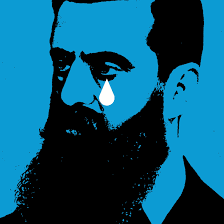
It took us almost 2000 years to regain Jewish sovereignty. When Theodore Herzl championed a national homeland for the Jewish people and created modern political Zionism, he envisioned an open society where Jews of all stripes and colors, all beliefs and cultures could feel at home. You can read about it in his utopian novel, “AltneuLand” (Old-New Land), published in 1902. If you are following the current Israeli political crisis, you know that many observers believe that the crisis concerning the “judicial overhaul” is about Israel’s national identity. Will it continue to be open and innovative, pluralistic, democratic? Will it be the Israel we are so proud of?
Tali texted me yesterday and asked – are we an ethnicity? I don’t know if she was filling out a form or where this came from. (Texts are limited in the amount of information they impart.) But I answered: “Yes, and more. Its complicated.” Well, it is and it isn’t. We are a people; we care about each other; we care what happens to Jews wherever they live. Do we care more than we care about non-Jews in Asia or Africa or Central America? Well language tells a little bit of the story. We divide the world into Jews and non-Jews. We care about people in need everywhere, but we begin by caring about our own.
And so Tisha B’Av. If nothing else, tells the heartbreaking story of Jewish powerlessness. It reminds me how much and why I care about the future of Israel society. I am so proud of the scope of the Israeli protesters who are writing a new chapter in Herzl’s novel. They are fighting for the soul of the nation. They give me hope and that’s not a small thing. I am proud of every step they take in their march from Tel Aviv to Jerusalem, in their willingness to stand up for their ideals. I may be idealizing them and maybe a little naïve, but I think they could teach us a thing or two.
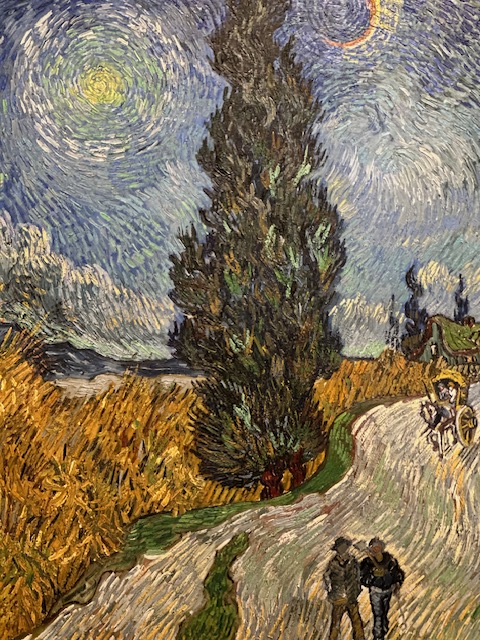
We were in New York a few weeks ago. Saw two shows and went to the Metropolitan Museum of Art squeezing into two exhibits: Karl Lagerfeld: A Line of Beauty and Van Gogh’s Cypresses. The exhibits and the shows were radically different: Parade – about the Leo Frank lynching somewhere outside of Atlanta in 1915 and A Beautiful Noise – the story and music of Neil Diamond from Sweet Caroline to Coming to America. We can talk about Parade in a different post.
Eileen and I were captured by A Beautiful Noise; loved the music; you could sing it; loved the glitter and the sequins; felt so good, so good, so good. Things I did not know: unlike many contemporary actors and performers, Neil Diamond never changed his name. He was born Neil Diamond and still is. He didn’t pick up the guitar till he was 16. Many of his songs are deeply personal mirroring different stages of his life. And so much of it is about acceptance and loneliness. I hear his music differently now: self-reflective and even soul searching. You got to get past the façade of bright lights and shiny costumes. Just like when you love someone you love not only their persona but also the person they are within, with all the beauty marks and all the flaws, with all the strengths and weaknesses. You see, I am not a music critic, and I am not a psychoanalyst. “I am I said, to no one there and no one heard at all, not even the chair…” We all want to be heard, noticed, felt that this one life we have is impactful.
Some of us sing; some of us tell stories; some of us write; some of us nurture; some of us teach; some of us provide; some of us heal; some of us listen, some of us create; some of us grow things; some of us paint. And some of us struggle and can’t find the road back. It might be ridiculous or ludicrous to pair the two but the Van Gogh exhibit at the Met wants “in” to these words. The image at the top of this is Van Gogh’s “Country Road in Provence by Night”. He was obsessed with these cypress trees. He calls them “flame like” and even writes, “no one has yet done them as I see them.” Maybe it’s the loneliness theme. I often wondered do you have to be lonely or besieged to be creative. Is suffering the secret ingredient in the paint on the palate?
The painting isn’t as famous or as intense as Starry Nights, but it speaks to me about the life we have been given and the road we all are invited to take – one that winds through and by the trees. There are probably many paths, and they change as we grow, age, mature, become. The challenge is to recognize it, stay on it, celebrate it, affirm it, walk it with as much joy as we can muster no matter what God/Life/Chance/Luck bring us. Van Gogh died of suicide. Neal Diamond has Parkinson’s. What do we really know?
I’m waiting for Kohler to call me back. The kitchen faucet spray button has fallen off and I can’t get it re-attached. Neither can the very nice person at Ferguson who looked at it and said, “here is the model number and the name of the faucet. Try calling Kohler and see if they will replace the head.” After several attempts at sending me to their website, the automated voice command told me I had a 12-minute wait. I didn’t take that as a promise. Eventually they offered me one of those call back options when the next available customer service rep was available during normal business hours.
I am optimistic but realistic. So much about life is about waiting. On my good days I can transform my waiting into anticipating. Like right now I am anticipating that this is an exercise in futility. It turns out I am wrong. It turns out I have to take back all the negative thoughts I had about getting a return call. And I have to take back all the predictions that they wouldn’t do anything about my issue. Andrew called me back just now and asked that I send them a picture of the broken piece to their email address. They say they are replacing the head! Ten to twelve business days. I can wait that long.
And then the phone rings again. Well, it doesn’t actually ring. Cell phones sing; cell phones buzz; cell phones chime; they make tonal music. But it doesn’t matter. In an instant the minutia of kitchen faucets became inane. The other side of the line (although there is no line anymore) was in crisis. It jolted me back to how tenuous our existence. How true the Yiddish saying that roughly translates into: We plan; God laughs. How we think we are in control of our lives, and we can expect things to evolve in the order we have programmed – but – we all know – life is unpredictable, and the art of living is managing the unexpected.
That brings us back to waiting. We expect our lives to progress in an even course. My Aunt Molly whose life was filled with sadness would say: Don’t kid yourself- we are all just waiting for the other shoe to drop. In Jewish tradition we know about that other shoe just as we know about waiting. Some of us wait in-between eating milk and meat. We wait after a loved one has died before resuming our everyday routine. We wait for Yom Kippur to end so we can break our fast. We wait for the Messiah to change the arc of history. We wait for humanity to live up to its potential.
There is an argument about the characteristics of waiting. Do we just wait and anticipate that there will be a Divine intervention, or do we fill our waiting hours with learning moments finding patience and clarity as we hone into a new perspective about ourselves and the quality of life around us. Waiting it turns out is not passive. It gives us room to grow and time to process the unexpected. Waiting gives us opportunity to change paths; to deepen our experience of the now; to be surprised or disappointed; to feel.
I’m getting a new faucet. It’s the little things, you know.
I am watching my garden grow. It takes a lot of patience. It also takes a lot of care. It has taught me that I’m not so good at waiting; I’m also not so good at getting down on my knees and weeding. I’m pretty good at watering and fertilizing but don’t ask me how many little pellets per square foot – for me it is a good deal of intuition and faith – well really – hope. All the professionals tell me that this year has been tough. The winter had a hard freeze when the temperature hovered around zero and the hydrangeas rebelled. So, it is a slow return to summer’s glory.
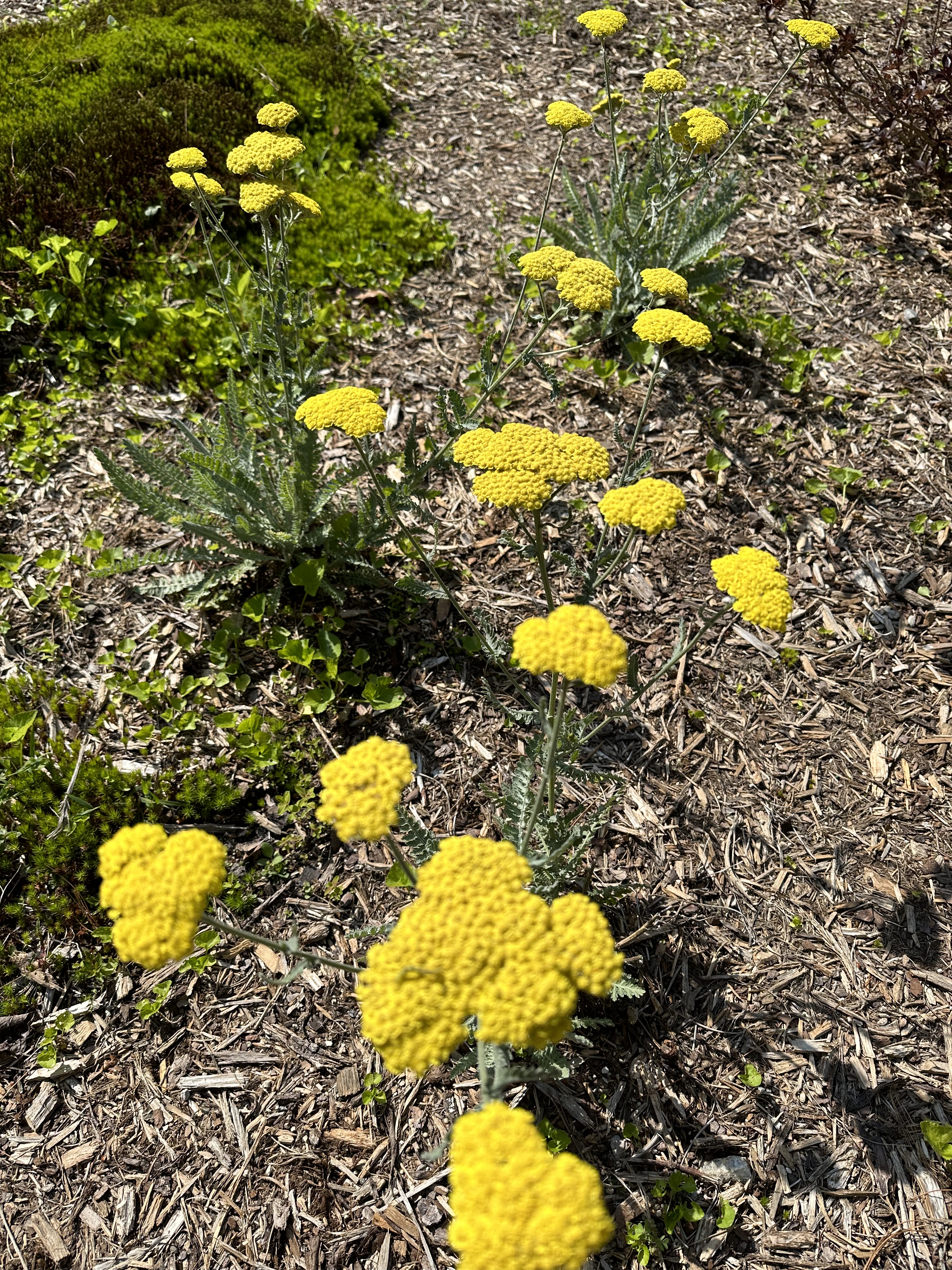
I expected a rainbow of colors by now. What I got so far are these yellow Yarrows. (Although to be fair the purple Irises have been both faithful and reliable, but they are unhappily very short lived and I saw a few buds on some blue geraniums.) It is quite a spiritual exercise, this waiting and watering, watching and worrying, weeding and wishing.
I never heard of Marc Hamer till I read a piece in the NYT. In his latest memoir: “Spring Rain: A Life Lived in Gardens, he writes, “a garden is always a place of worship even if it’s a really crappy one.” If I can extrapolate from his words: Worship is believing that there is a power (or Power) in the universe that promotes growth. Some people believe that power listens to prayer. Some people believe that power invites us to find the oneness that unites the flower and the seed. In Hamer’s reflections, “kneeling in the garden is like bowing to the world that made me.” It is acknowledging – there is a place for us. It is hands and heart united in gratitude.
I believe in my garden, but I have a fair amount of garden jealousy. I pass neatly coiffed landscapes with defined beds and barely a weed to be seen. That’s not mine. At least not yet. But it won’t be that way forever. Eileen just bought me a new weeder that hopefully makes the process palatable. It’s Wirecutter’s favorite and called a Woodcraft Weeding Hoe. (Father’s Day you know and who wears a tie these days anyway.) I tried it out this morning. Here’s the challenge – is that a weed or wildflower? And what do you do with the mulch you have now dug up.
Never mind, it is good therapy. If I can keep the red ants and chiggers away from me, it is a healthy form of meditation. Never mind, I love how it is never static, always changing, always becoming. I love how the dirt under my fingernails (no matter how thick the gloves) is a prayer to creation and all that is yet to be.
I was going to call this Two Weddings and a Funeral but it turns out that it is a South Korean Romcom about a gay man and a lesbian woman who marry to protect their secret lives in a society filled with taboos and judgement. I actually had my numbers wrong. I was thinking of “Four Weddings and a Funeral” the British comedy with Andy McDowell and Hugh Grant. The plot is predictable, the ending happy and the stars ever so young.
All of this is in my head because our summer is its own movie: two weddings, three graduations and one memorial celebration of life. All of them involve a plane or two and are forcing us to make both physical and digital folders for all the arrangements. Not complaining here at all. The first graduation (Jacob, your turn for a shout out) has just ended. And I was so aware as I watched the ceremonies all over the Duke campus, how blessed we are, living the Shehecheeyanu moment. (For those readers who are Hebrew challenged and find the word hard enough to read and almost impossible to pronounce: it translates ‘who has kept us alive’.)
We take that blessing so lightly. Maybe it’s the belief structure around it, praising/blessing God for being so personally interested in us, watching over us, preserving us, and allowing us to reach this moment. Maybe it’s the familiarity or the frequency. Jewish tradition invites us to say the blessing on so many occasions from a New Year to the first night of any holiday to new life events. For me I think it’s the theology: Does God need our blessings? Or do I need to bless. Meaning: I need to recognize the specialness, sanctity, uniqueness of the moment. Does God need our praise or do I need to stop and mark with gratitude and humility how lucky (read ‘blessed’) I am to be alive, aware, and sentient at this time.
I came back from the weekend and the next morning took a Yoga class. At the end of Savasana (the final resting pose in many Yoga classes), the instructor read a teaching about God and Oneness. It taught how many of us tend to think of God in dualistic terms. That there is God and there is us. God is up there or out there, and we are down here, separate from each other. But all that is illusion. There is only oneness. There is only “existence” and as we live in God so God lives in us. We are connected to each other, to the world, to the cosmos both inside and out. We may perceive moments and events as separate, but they flow into each other and out of each other as the waters in a bubbling stream.
All of this is my way of saying Shehecheeyanu again. Not just for the life events of this summer but for every moment. Our being is a gift. Life is a gift and gratitude is the foundational posture upon which a life of meaning stands. So, thank-you to our 3 graduates: Corey, Maya and Jacob. You remind me how sacred life can be. You remind me we are connected in ways astounding and holy. I think I will call them God Strings.







 rabbiunplugged