Choosing to Hope

Some of you are not going to like this but I am “unplugged” which means I am not connected to any power grid that might like to restrict what I have to say. So, I am going to tell you that I haven’t been this excited about the possibility of our national politics as I am right now. And I am willing to admit that I might be being manipulated and or naïve and or played but I like the feeling, and it is a combination of hope and joy.

There you have it. If you have been watching the Democratic Convention you know where this is all going. I am excited to vote for something once again as opposed to voting against someone. I love the enthusiasm; I love the excitement; I love the belief that this country with all its flaws and problems is an America filled with promise and filled with potential. And even if we disagree or differ in how we see tomorrow or yesterday, we are one nation, indivisible with liberty and justice for all.

I just finished rereading “When Breath Becomes Air” by Paul Kalanith. One of the sentences that stopped me was: “The word ‘hope’ first appeared in English about a thousand years ago, denoting some combination of confidence and desire.” I wonder if that means that people didn’t hope before or there was just no way to express the emotion in English. Actually, I’m not really sure what that sentence means. I don’t think people can live without hope. Or maybe I shouldn’t generalize. I can’t live without hope.

The dictionary defines hope as the expectation or belief that something expected will happen. I think you can hope that something unexpected can happen as well. Like: I hope there will be a hostage deal and Hamas and Iran will stand down and Israel can live in peace. Like: I hope that we can have a substantive discussion on the future of our country and stop the name calling and childish snipes at one’s race or name. Like: I hope that the next Congress can govern and not quibble and put our country’s interest in place of their own. Like: I hope my grandchildren’s’ America is safer, brighter, fairer, more prosperous and healthier that my own.

I happen to believe that hope and faith are interconnected. In my world to have faith is to believe that your life has purpose; it is a gift; you are here to make this world a better place, sometimes just by smiling, sometimes just be voting, sometimes just by loving. Neither faith nor hope are passive – they demand action, and they have the power to change our world.

By the way the image at the top is moss. Moss has a mind of its own, growing in really unlikely places. I like it cause it is fairly unpredictable, like hope.

.
Happy Anniversary


Dear Gentle Reader,

(To borrow a phrase from Lady Witherspoon of Bridgerton fame.)

You might remember my finding a stack of sermons in our storage unit all typed (like on an electric typewriter) on 5 X 7 cards – mostly green, some blue, all of them pre-word processing days from the mid-70’s to the early 90’s. They are mostly High Holy Day sermons and tend to have some common themes.

Here are some general impressions. They are too long and tend to be repetitive. They are inconsistent but some are brave, and some are foolish, and all try really hard to be relevant, some succeed. They are also incredibly “chutzpadik”. Who am I to be saying these things? Who am I?

Take the one about “Love and Marriage.” I didn’t date a lot of these sermons but in researching the books or articles I quote I think this one is from the mid-70’s. That means I was in my mid-thirties and had been married for maybe ten years. What the ……. did I know about love or marriage?

But it did begin with a great Chasidic story about two boys who used to like playing Rebbe when their father (the Rebbe) was taking a Shabbat afternoon nap. They would take turns and critique each other’s ability to model their father when he counseled people who came for advice. This time the congregant was asking his Rebbe about marriage as he recounted the quality of his relationship with his spouse. At the end of the play acting, the son who was playing the Rebbe asked his brother to critique his “performance”. His brother said: “You did great, and you said all the right things, but you forgot the most important piece of any Chasidic session. Abba (dad) always began with a sigh – all Chasidic stories must begin with a long, slow, deeply felt sigh.

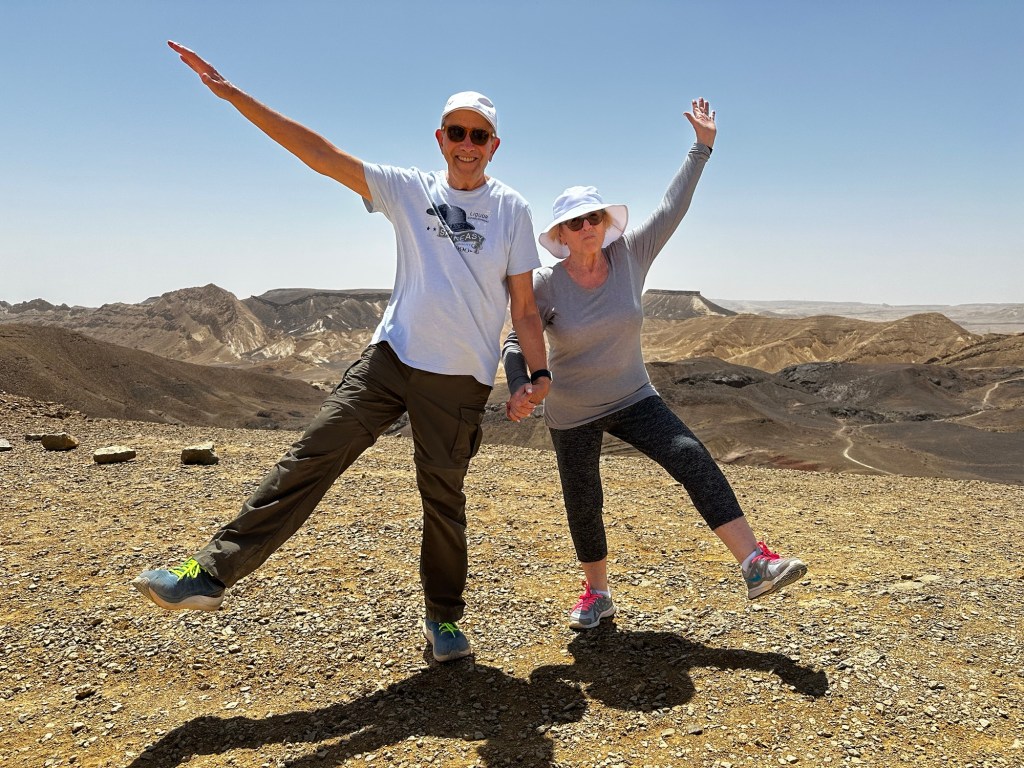
And so it is. Today is Eileen and my anniversary. And I think a sigh is appropriate – the sigh that slows us down and invites us to reflect on the days and years of our marriage. The sigh that admits not every day was perfect but year after year we turned our challenges into blessings. 

Sighs come in many variations. There is the sigh that says: here we go again. Life has a way of repeating lessons unlearned. And it is hard to change; it is easy to fall back on old habits and ways. It is easy to point your index finger at and forget that there are three others pointing back at you. It is easy to forget the word of the day in a marriage is “us”.

You are probably getting the wrong impression here. Another sigh. We have and we are blessed. Not only with children and grandchildren who are a constant source of joy and pride. Not only with relatively good health given our years. Not only with affluence and influence and meaningful roles we played in society. Not only with people who love us and people we love. Not only with laughter and joy and even sorrow and loss – but most of all, we are blessed with each other in good times and bad times, in the work we do when we say: I love you.


There is a Painting

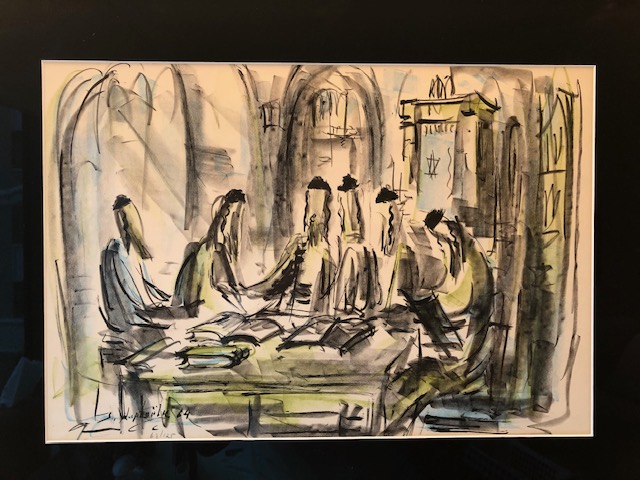
There’s a painting in our office in the new apartment we are still finishing in the high rise building near the mall in the city where we rented our first apartment when we came here what now feels like a long time ago and it was. It is a gaggle of men studying. I started to say a group of Rabbis but why do I assume only Rabbis study. I guess you could ask why only men but that’s a different discussion. They sit pretty close to each other, breathing disagreements and questions on each other’s faces. Things we notice now.

I replaced the glass and the matt after the glass cracked in our move. It’s been with us ever since I was a student Rabbi in Vicksburg, Mississippi in 1965-66, a gift from the congregation after my one-year internship with them. They were incredibly warm, gracious and proud Jews of the South and put up with this naïve and inexperienced young Yankee from Boston. The congregation had been founded officially in 1865. But Jews have been living in Vicksburg for almost 200 years.

 It is a Zvi Raphaeli Litho. (Whatever that adds to this story. But in Jewish tradition it is imperative to quote your sources and name your teachers.) And they teach, these lines of color, strokes from a paint brush of the artist’s creativity. They teach about time and Torah; they teach about nostalgia and memory; they teach about an eternal quest to make sense of this life we have been gifted. One man is sleeping, maybe just a quick nap. Or maybe it is the Rabbi and they learn more from his silence than his words. I know about silence. Sometimes it is distant and cold, angry and bitter. Sometimes it is reflective and soft, harmonized compassion. Sometimes it is wise. I try to remember that simply refraining from speech opens up the moment to unforeseen potential. Speech is populated with words I already knew; silence celebrates that there is more to learn from each other.

My men are not silent. They are arguing about tomorrow. What will be its shape and how will we rise from this table piled with ancient tomes?  I would recommend to them The NYTimes article “No One Knows What’s Going To Happen” (Mark Lilla) as a worthwhile antidote to the hints they scour in the texts before them. In a way it is an echo of what happens when you are willing to live with the silence. Everything we say about tomorrow is a guess. Some guesses are more educated than others, but our predictions depend on so many variables including will my scholars in the portrait wear a mask when they leave the House of Study. Including will my scholars pray with their deeds and not just their words.

There is a very hard lesson to be internalized here. “Human beings want to feel they are on a power walk into the future, when in fact we are always just tapping our canes on the pavement in the fog. A dose of humility would do us good in the present moment. It might also help reconcile us to the radical uncertainty in which we are always living.” (NYT: Lilla. 5/24)

Scary this uncertainty. But if we are honest, we were never in control. We just lived as if we were. It was way more comfortable and settling. This stuff is tough but you all know that and didn’t have to read this far to hear me say it. But back to my scholars. I think what got them through is they had each other. If nothing else that was a constant worthy of emulating.