Happy Anniversary


Dear Gentle Reader,

(To borrow a phrase from Lady Witherspoon of Bridgerton fame.)

You might remember my finding a stack of sermons in our storage unit all typed (like on an electric typewriter) on 5 X 7 cards – mostly green, some blue, all of them pre-word processing days from the mid-70’s to the early 90’s. They are mostly High Holy Day sermons and tend to have some common themes.

Here are some general impressions. They are too long and tend to be repetitive. They are inconsistent but some are brave, and some are foolish, and all try really hard to be relevant, some succeed. They are also incredibly “chutzpadik”. Who am I to be saying these things? Who am I?

Take the one about “Love and Marriage.” I didn’t date a lot of these sermons but in researching the books or articles I quote I think this one is from the mid-70’s. That means I was in my mid-thirties and had been married for maybe ten years. What the ……. did I know about love or marriage?

But it did begin with a great Chasidic story about two boys who used to like playing Rebbe when their father (the Rebbe) was taking a Shabbat afternoon nap. They would take turns and critique each other’s ability to model their father when he counseled people who came for advice. This time the congregant was asking his Rebbe about marriage as he recounted the quality of his relationship with his spouse. At the end of the play acting, the son who was playing the Rebbe asked his brother to critique his “performance”. His brother said: “You did great, and you said all the right things, but you forgot the most important piece of any Chasidic session. Abba (dad) always began with a sigh – all Chasidic stories must begin with a long, slow, deeply felt sigh.

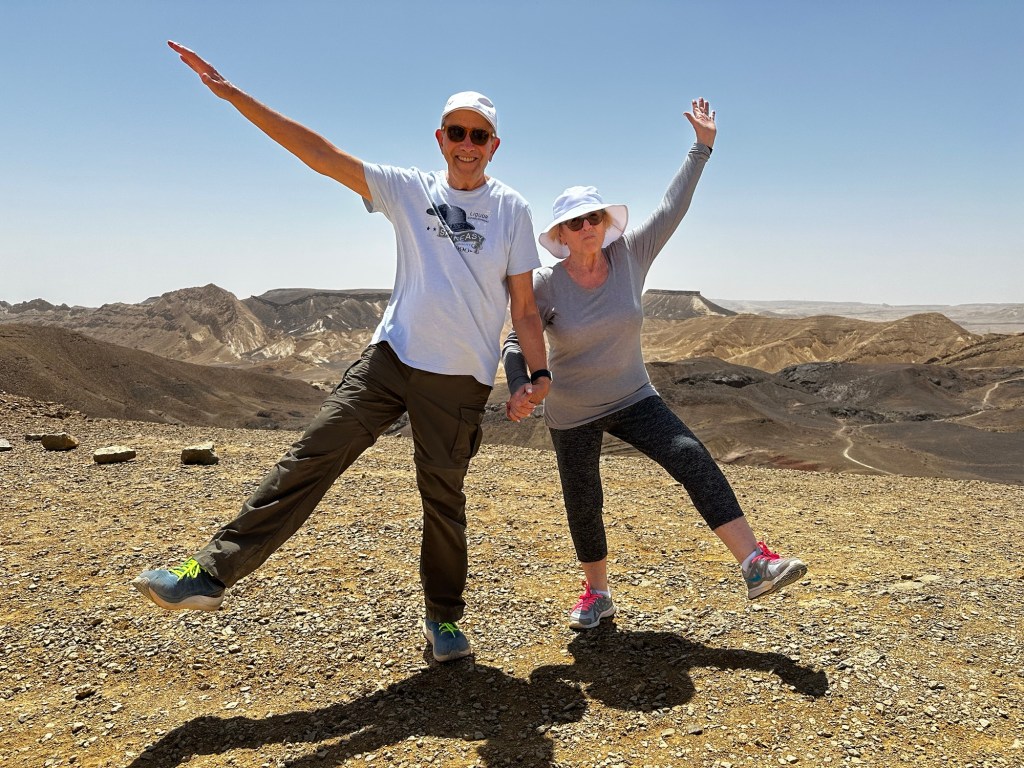
And so it is. Today is Eileen and my anniversary. And I think a sigh is appropriate – the sigh that slows us down and invites us to reflect on the days and years of our marriage. The sigh that admits not every day was perfect but year after year we turned our challenges into blessings. 

Sighs come in many variations. There is the sigh that says: here we go again. Life has a way of repeating lessons unlearned. And it is hard to change; it is easy to fall back on old habits and ways. It is easy to point your index finger at and forget that there are three others pointing back at you. It is easy to forget the word of the day in a marriage is “us”.

You are probably getting the wrong impression here. Another sigh. We have and we are blessed. Not only with children and grandchildren who are a constant source of joy and pride. Not only with relatively good health given our years. Not only with affluence and influence and meaningful roles we played in society. Not only with people who love us and people we love. Not only with laughter and joy and even sorrow and loss – but most of all, we are blessed with each other in good times and bad times, in the work we do when we say: I love you.


Let The Light ShineThrough

IMG_3828

I spoke about Pope Francis on Yom Kippur morning at Temple Israel. His style of leadership was the unifying scaffolding upon which I built my sermon for this most holy of holy days in the Jewish calendar. I was able to tie in Jonah (the book not Hill) and the theme of reflection and self-assessment that is at the heart of this Day of Atonement. The Pope’s visit and his popularity became the refrain for me to ask one of the Day’s fundamental questions: when all is said and all is done how we would like to be remembered.

Now the Pope’s visit is history.   He is back in Rome and CNN can return to its regular programming.  I am not an expert in Catholic doctrine or ritual but this is what I learned from him as a Rabbi and as a plain old ordinary Jew and a plain old ordinary human being.

I learned that there are no plain old ordinary human beings. Whether it was planned or orchestrated or not, it doesn’t matter. Every time he stopped his motorcade and picked up a baby or walked over to a young boy with disabilities or met with people incarcerated for terrible crimes, he underscored a fundamental religious value that at the core we are souls precious and unique, created in the image of God.   And don’t let God language get in your way of understanding that. It is a message that celebrates our humanity and our shared responsibility to one another. It is the sacred voice of collective wisdom speaking: we are kin and we share one small planet in a seemingly cold, vast, infinite universe. Let’s take care of it and each other.

This is what I learned as a Jew. This is not my grandparents’ Catholic Church. It is still a huge and wealthy institution that loves its ritual, its incense, its symbolic gestures and its mystery. But at least under Francis’ leadership, there are conscious cracks and openings for the message that a Jewish Jesus taught as an itinerant Rabbi/Sage/Prophet/Story teller and parable maker in and around Galilee and Jerusalem. And this is what I admired. The message of forgiveness, love and acceptance is real and it is to be acted upon and lived when you sit in your house, when you walk on the way, when you lie down and when your rise up.

This is the challenge to me as a Rabbi (and you can substitute minister or priest and lots of other professions, not just religious).  You cannot let the institution or other people’s expectations define you. The weight of all our traditions can force you into a mold that is at the same time comfortable and confining. Maybe I am reading into it, but I think you could see how heavy the past was in just the way Pope Francis walked: slowly, deliberately and balancing the miter on his head. And yet, he always walked forward, deliberately so. And he always seemed to let his inner light shine through. And he always seemed to be his own person – what a gift to us all.