Memories & A Little Light

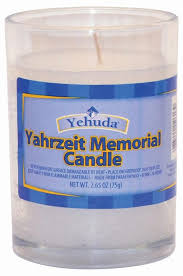
The Yahrzeit candle is burning on the kitchen counter. It is the only light in the room on this pre-dawn morning. I remember when these candles of memory were taller and wider, and my Aunt Molly used to save them for drinking glasses. Aunt Molly was the queen of candles. She experienced many losses in her life and on Yom Kippur there was a tray full of these flickering lights, each one lit with a tear and a sigh. Her greatest loss was her daughter Barbara, who according to family legend, died on the operating table having an appendectomy when the hospital lost power during the 1938 Hurricane. (Hurricanes weren’t named until 1950).

We don’t grieve like Aunt Molly anymore. (Although in the Australian series, “A Place To Call Home”, that Eileen and I are addicted to Sarah lies down on her husband’s grave to talk and connect with him.) As a kid, visiting my grandparents’ graves with Aunt Molly I remember how they used to have to hold her up as she went to throw herself down wailing, “my Barbara”.

Morning has broken (I know: “like the first morning…”). The candle on the counter still flickers and the memory of my mother-in-law hovers to be inscribed and internalized in our goings and comings. Bea wasn’t a great sleeper, and neither was I. After we met at the refrigerator door in the middle of the night, she learned to wear a bathrobe as she came from her bedroom. We got to know each other there: she with her cornflakes, me with whatever I could scrounge. She was her Hebrew name: B’rachah – meaning blessing.

I am not sure what I think these compact candles do. The author of Proverbs said that “the human soul is the light (Hebrew: candle) of God.” I don’t know what that meant back then. I am not sure I know what it means now. I do know that last night when we lit the candle, Eileen brought her mother up to date with the goings and comings of the family.  She told her “I wish you could have lived longer to see the beauty and the joy of the last 30 years.” There is nothing terribly rational about that but there is everything that is true on so many levels. Life is about memories and we strive to make them sweet and meaningful. It’s been a tough few months to do that. And so my candle whispers:

To making new and better memories in the New Year: Shana Tovah

“Morning has broken

Like the first morning;

Blackbird has spoken

Like the first bird.

Praise for the singing

Praise for the morning

Praise for them springing fresh from the word.”

(Cat Stevens)

To making new memories in the New Year: Shana Tovah

Which Brings Us To This Season

IMG_4041

Not Just For the Golfers Among Us

I was in the deep grass, pretty far from the hole. It was a par 5 and it was a good drive for me. I knew I could get to the green in 3 if I just made this second shot count. I took out a long club and took a practice swing. The grass was thick and sticky but I knew I could power through it. If you are a golfer, you know the end of this story. If not, let me tell you it wasn’t pretty. The grass caught my club; the ball veered off to the right and practically went nowhere.

Greedy is what I said out loud – I can’t write what I said inside. But the more I thought about it, “greed” was the wrong word.   I think it was hubris, loosely defined as the belief that I am invincible and can do almost anything I want or set my mind to. I should have picked a different club, one that was more forgiving but didn’t get the distance I was reaching for. I should have listened to my inner self and played it smart rather than macho. I should have learned from the last time I was in the same place.

I have a tendency to keep repeating the same mistakes, not just in golf, but also in life, in relationships, in love. The grass was calling out to me and trying to teach me: learn from your past; choose a different club and stay down, stay focused. The hybrid in your bag is called “forgiving” for a reason. Which brings us to this season and the New Year that begins with the shrill and broken sounds of the Shofar.

Traditionally the ram’s horn plays four notes: one is fierce; one broken; one triumphant, one long. Each note touches a different part of my soul. The fierce tekiah opens me up for the potential being birthed by the New Year. The broken shevarim wails and speaks to me about missed opportunities for wholeness. The triumphant staccato notes of teruah declare you can do it – you can take all the fragmented pieces of your past and glue them together. The very act of trying is itself holy.

It’s all about the effort and the club you choose from your bag. Pick one that is forgiving. Swing smooth and steady and let the club do the work. Listen to the sound of tekiah gedolah (the great and long note of promise). It reaches deep inside of me; reverberating, resonating, and repeating. Trust yourself; have faith. No matter how deep the grass, how dark the day, how heavy the task, the Shofar promises: This is a new start; this is a new chance; this is a new year. Enjoy it and use it well. Happy 5776

Standing Tall

IMG_3998

My mother and father were just about the same height, but somehow she always seemed taller. Maybe it was the shoes or maybe the way she carried herself in a proud but not superior Boston kind of manner. Or maybe the cigar, which was a horizontal point of reference, either in his hand or mouth, moderated his stature so it appeared that he was shorter.

I don’t think it ever bothered him. Generally, he was easy going, giving, happy and hard working, always trying to do more for his family. Charlie, with a broad “A”, almost no “R”, was a good person who struggled with his own successes and disappointments. He was a pharmacist and a sales rep for a pharmaceutical company, with a drugstore in the trunk of his car always full of samples. There was no Medicare Part D or Drug plans then, but there was Charlie with an open hand and heart. But when he perceived that people took advantage of him, or something went wrong in the house that neither my sisters nor I understood, you could feel the stillness and almost see the anger. It wasn’t like a match that flares and goes out; it was this steady kind of burn, the water in the pot just at the point of boiling over.

I feel guilty even writing this but I think he had a hard time letting go of the hurt, but then again, what do I really know of what transpired right before the flame was lit. This I do know: I have my own issues with forgiveness. I have my own challenges to work through and overcome. I somehow find it easy to shut down and retreat into silence when I am hurting. I own it and there is no blame or finger pointing here. We all have different modalities in our arsenal of coping and we are constantly learning and relearning them in every situation.

Enter Selichot, the prayers of forgiveness that whisper hope and renewal to me. Enter Selichot announcing a New Year is coming; a new time for me to begin again; a moment of growth and promise. Enter Selichot initiating a process of review and assessment for those who stop, look and listen. The liturgy, the music, the colors, the sounds gently surround me with compassion and concern. I need Selichot; I need a mechanism that invites me to face how I deal with the injuries I have felt and the hurts I have inflicted. I need Selichot; I want to enter the New Year fresh and rejuvenated. I want to enter it forgiving and forgiven. I love that our tradition gives me a chance to get it right and make it better by facing my own personal failings. I love the time worn words of our liturgy that are consistently pumping out ways to reflect and view a different image in the water.

When those “Al Chets -For the Sins we have committed” jump out of the prayer book, I’m there. Sometimes they are listed in alphabetic order; always in the plural. The sages understood that we are all in this together and no matter how individual our failings may be; it is human to fall and get up, to stumble and stand tall. “Arrogance, bigotry, cynicism, deceit,” I often don’t make it past “A”. The samples in my father’s trunk healed and restored. The samples in mine are the regrets, the hurts, the disappointments, the missed opportunities, the challenges I haven’t met, the words spoken without thinking, the self absorption that comes so easily, giving with not so invisible strings attached or giving grudgingly; taking eagerly. I could go on; in the quiet of the night, I’m good at listing all the ways I have disappointed others and myself.

But this is what Selichot says to me. Consider your deeds; reflect on who you are and who you wish to be; ask for forgiveness and whatever you mean by the word God will pick you up, clean you, brush you off and set you on a new course. It is work like all prayer, but it is worth it. Refreshed, renewed, ready for the broken call of the shofar to proclaim a New Year and another opportunity for wholeness.

(This post was originally published on Ten Minutes of Torah http://reformJudaism.org)